

If you’ve ever wondered how much water should you drink daily? You’re not alone. Hydration isn’t just about avoiding thirst; it’s about supporting every system in your body so you can feel alert, move well, digest food, think clearly, and recover from stress or workouts.
Experts have long debated a single “magic number,” and the honest answer is: it varies by person. But understanding what your body actually needs — and why — matters if you want real, lasting wellness. Let’s break it down in a way that actually makes sense.
Water isn’t just a beverage — it’s a physiological necessity. Your body is 50–65% water as a baseline, and that water circulates through every cell, joint, nerve, and organ. Proper hydration:
Helps regulate body temperature
Keeps joints lubricated
Supports digestion and nutrient delivery
Assists detox pathways
Helps your nervous system communicate efficiently
When you’re under-hydrated, even subtly, it can show up as low energy, headaches, muscle tension, foggy thinking, mood imbalance, or sluggish digestion. These aren’t “normal aches,” they’re signs your body is asking for support.

There isn’t one perfect answer for everyone — but there are evidence-based starting points:
For an average adult in a temperate climate, leading health organizations note that total fluid intake (from drinks and food) falls around:
About 2.7–3.7 liters of fluid per day for most adults (that’s roughly 90–125 ounces).
Instead of rigid rules like “eight glasses,” what matters more is staying in tune with your body and adjusting for:
Activity level: If you’re moving, sweating, or training, you need more than a sedentary day.
Climate: Hot, humid weather increases losses; so does dry indoor heating.
Stress & detox work: These processes use water to shuttle waste and support cellular repair.
Diet: Fruits and vegetables contribute water, and caffeine or alcohol can affect hydration balance.
Rather than a strict daily quota, think in terms of signals that indicate adequacy:
✔ You rarely feel thirsty
✔ Your urine is pale yellow or clear
✔ You retain stable energy throughout the day
✔ You’re functioning well physically and mentally
These are better markers than counting cups alone.
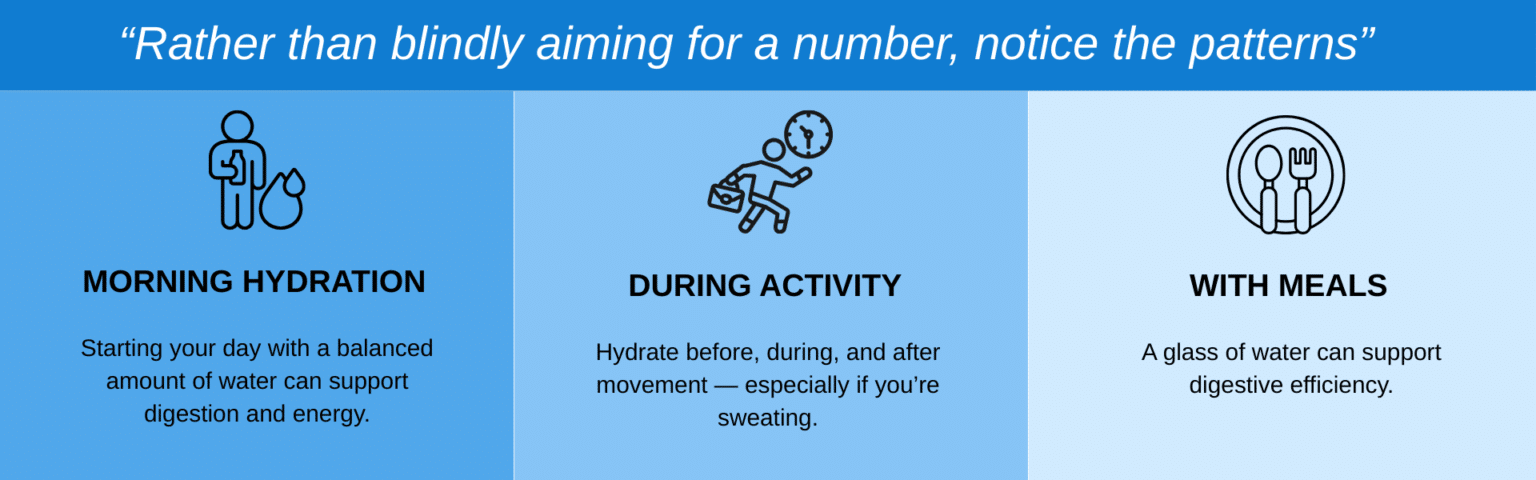
Not everyone fits the “standard” needs:
Athletes & frequent movers usually need more water to replace what was lost through sweat.
Warm weather & outdoor exposure increase fluid requirements.
Health conditions (like fever or digestive upset) can alter your hydration needs from day to day.
And while rare, drinking too much water — far beyond what your body can handle — can dilute sodium and cause imbalance. If you ever feel dizzy, nauseated, or unusually bloated, it’s worth evaluating whether intake and electrolyte balance are aligned.
Here at Omaha’s only structured hydrogen-rich water storefront and multi-modality, frequency-based wellness center, we approach hydration not as a slogan — but as a foundational component of functional health.
We blend science + energy + detox in a way you won’t find in a typical spa. Understanding hydration in context — how it affects your body systems, your daily performance, and your long-term resilience — is part of what makes our guidance different.
So the next time someone tells you to just “drink more water,” ask yourself:
Is it helping my body function better today? Or am I just checking a box?
Your hydration habits — like your workouts, your food, your energy practices — should be purposeful, individualized, and driven by real feedback from your body.